Showing posts with label Far North Queensland History. Show all posts

Thursday, November 4, 2010

Blast from the Past

I'm turning into a bit of a local history buff and have been trolling through online archived news items about this part of the world (where would we be without the intertubes?).

I recently made a trip out to Chillagoe with a load of old typewriters which hopefully will soon be on display out there (another story).

On the way to Chillagoe you pass through the deserted 'town' of Lappa Junction

This is how it looks today:

The Lappa Junction Station


The old Lappa Pub (link to local ABC)


This is what it was like in 1901:

The Queenslander (Brisbane 1886-1939)

Saturday August 3 1901

THE LAPPA-MOUNT GARNET LINE.

The "Cairns Argus" of 16th Julysays:—In the course of an interview whicha representative of this journal had on

Saturday evening with Mr. A. Overend, of the firm of Messrs. Willcocks and Overend, contractors for the construction of theLappa Junction —Mount Garnet Railway, he learnt that good progress is being made with the work. About 250 men are employed on the line, this number not including a good many who are engaged in getting timber for the railway or as teamsters. The clearing gangs have got past the ten mile from Lappa Junction with their work, which will go on uninterruptedly until the whole line—thirty-three miles in length—is cleared. The earth-works are in hand for the first six miles of the line, and here about fifty horses and drays are employed, besides the men. There will be a good many cuttings on this part of the line, and the men areabout halfway through one big cutting near Lappa Junction. The main camp is now at this place, but will later on be re-moved to the ten-mile, which will form theterminus of the first section. Messrs.Willcocks and Overend have bought the saw-mills at the 74-Mlle on the Chlllagoe line from the Chillagoe Railway and Mines, and will start cutting sleepers there immediately. It is intended to utilise the saw-mills where they are now situated while the contractors are getting timber for a mill on their own line. It is hoped that the line will be finished in twelve months, or three months ahead of contract time. The contractors are pushing on with it as quickly as possible. Men are voluntarily coming up from the South by nearly every boat to work on it, and, in addition, all the local men who apply and are suitable for the work are put on. When the construction is more advanced, a good many more men than at present will be engaged—in fact, something like a thousand could be employed. Mr. Overend left Cairns for a visit to the South by Saturday night's boat. His partner, Mr. Willcocks, is remaining at the seat of operations to direct matters.

Monday, May 31, 2010

Mount Mulligan


Sunset over Mt Mulligan


Mount Mulligan was a coal mining town that ceased to exist in 1958. The town is/was based at the foot of Mt Mulligan, named after James Venture Mulligan who sighted the mountain in 1874. Gold was discovered on the Hodgkinson River during Mulligan's 5th expedition in 1876. The discovery of gold brought a rush of prospectors to the area with camps and small settlements along the Hodgkinson river. Ironically it was coal that was being sought after at Mt Mulligan

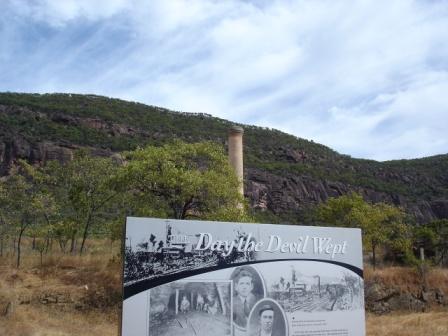
Ventilation shaft

Coal was discovered in the mountain in 1907. Commercial mining of coal commenced in approx. 1914. Coal was never very profitable as the method of mining was very expensive and labour intensive. The poor quality of the coal and transport problems ensured a slow decline of the township.


The town lasted for only fifty years but in that time it had experienced one of Queensland's worst mining disasters. A historical marker (below) erected in recent years tells about this disaster. "On Monday 19th September 1921 at 9:25 there was a loud explosion in the mine which killed 75 men. The explosion was heard 60 kilometres away at Mount Molloy".


The rusting remains of the town can still be seen and after a recent Mount Mulligan reunion the streets and important sites have been marked with signs. The only remaining intact building is the hospital which is now part of Mt Mulligan Station.


The Mt Mulligan cemetery, hastily built and consecrated after the disaster. More information here.


Mount Mulligan Disaster
After the Mount Mulligan disaster school children from around Queensland wrote to children at Mount Mulligan. Herbert Smithson from Mount Mulligan State school, whose father William Robert Smithson was killed in the disaster, replied to a child from Sandford, Mackay. He wrote:
Dear Schoolmates,
We thank you for your kindness & for yours letters of sympathy. Some day I hope to have the pleasure of meeting you. The accident happened at 25 past nine on Monday the 19 of September and they got all the men out some on Monday Tuesday Wednesday Thursday and Friday. The explosion started up at the fan and then in the tunnel. the blacksmith shop got blown to bits. The man who was in the shop got blown 200 yds away from the tunnel and after the explosion they went down the [mine] and worked all night and day looking for the men Everyday the people used to have breakfast dinner and tea up at the mine.
(Quoted in Bell, appendix B)
Herbert would go on to become a coal miner. In June 1942, while working at Collinsville State Mine, he was killed in an accident.

P. Bell, ‘If Anything, Too Safe’ (Townsville, Qld, 1996)


For a more detailed history of Mt Mulligan Click Here.